Industrial gas safety requires more than installing a detector and assuming the workplace is protected. Facilities that use, store or process gases need suitable detection equipment, regular inspections, clear emergency procedures and employees who understand how to respond to a warning.
Gas-related incidents reported in India during October 2026 have brought renewed attention to workplace and residential gas safety. On October 11, two employees died following suspected gas exposure at a steel plant in Bokaro, Jharkhand, according to The Times of India. On October 8, a reported gas leak from a cylinder pipe triggered a fire at an IIT Bombay hostel, injuring five people, as reported by The Indian Express.
These incidents involved different settings, and their reported circumstances should not be treated as proof of a common cause. However, they highlight why identifying gas hazards and preparing for emergencies are important. For facility managers, the key question is not simply whether a gas detector is installed. It is whether the overall safety arrangement is suitable, maintained and ready to respond.
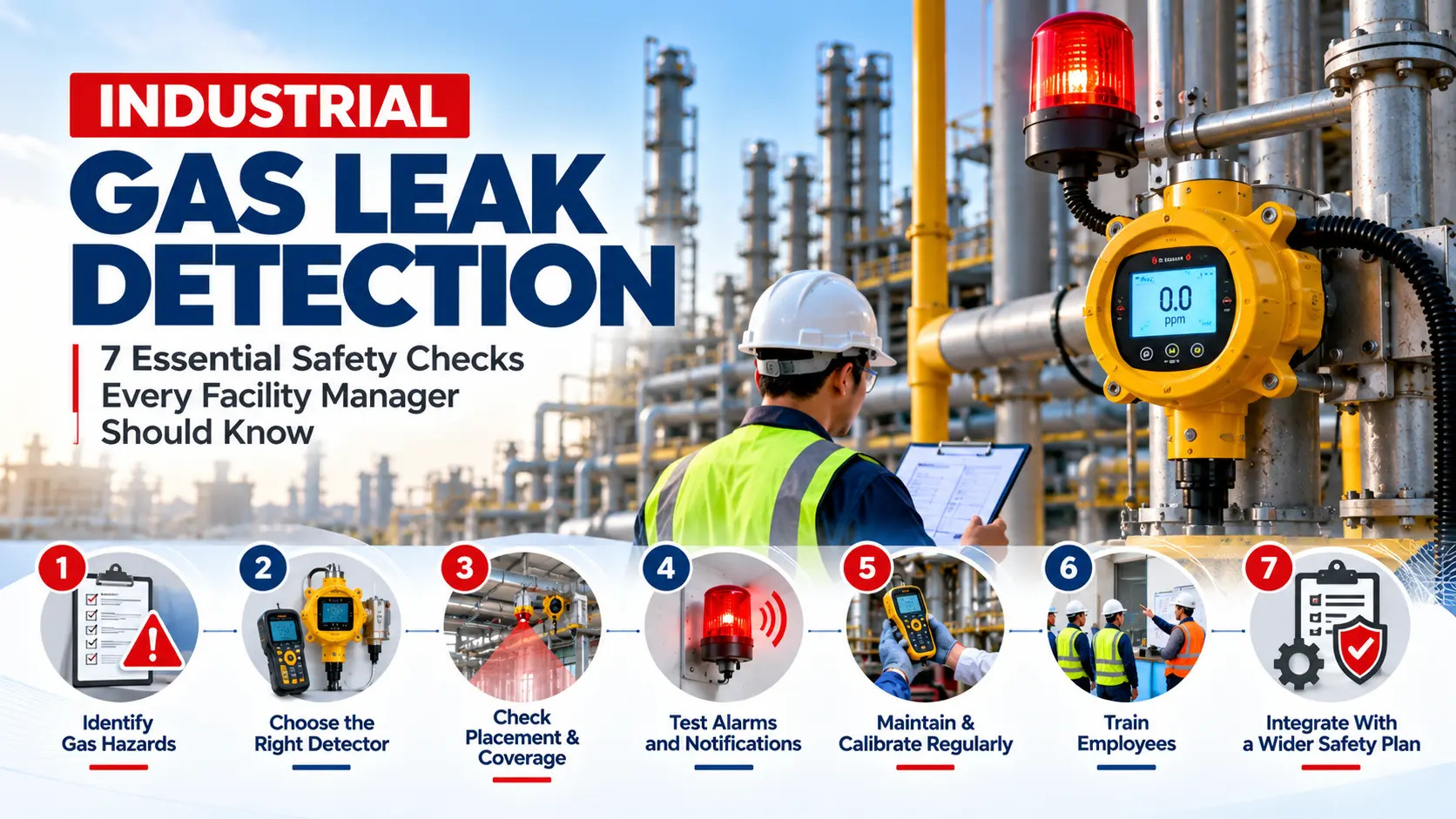
Here are seven measures to include in an industrial gas leak detection review.
Before choosing equipment, understand the gases present in the facility and the risks associated with them. Different gases have different characteristics. Some are toxic, some can displace oxygen, and others can create a fire or explosion hazard when the right conditions occur. A detector designed for one gas may not be suitable for another.
Review safety data sheets, equipment documentation and relevant process information. A competent professional can use this assessment to determine the type of hazardous gas detection required and identify where additional controls may be necessary.
An effective industrial gas detection system starts with the correct equipment selection. Choosing a detector simply because it is inexpensive or commonly used may not provide suitable protection for the facility.
Evaluate the following before purchasing or specifying a system:
Gas compatibility: Confirm that the sensor detects the specific gas present in the workplace.
Operating conditions: Consider temperature, humidity, dust, vibration and other environmental factors.
Detection requirements: Check the intended measuring range, response characteristics and alarm settings.
System compatibility: Determine whether detectors need to communicate with alarm panels, control rooms or other safety equipment.
Product documentation: Review manufacturer instructions, applicable standards and relevant certification requirements.
Fixed detectors may be appropriate for continuous monitoring in selected areas, while portable detectors can support certain inspection and worker-monitoring activities. The choice depends on the site assessment and the intended use.
A detector cannot provide reliable warning if its location does not allow it to detect the relevant hazard effectively. Gas movement depends on factors such as gas density, temperature, pressure, ventilation and airflow. Therefore, sensor placement should not be decided using a simple rule that applies to every gas and every building.
A qualified professional should determine the appropriate detector locations and coverage based on the manufacturer's instructions and site-specific risk assessment.
Detecting a gas hazard is only useful when the information reaches the people who need to act. Facility managers should inspect the complete warning process, from sensor detection to alarm notification and emergency response.
Testing should follow documented procedures and the equipment manufacturer's guidance. Never deliberately release hazardous gas to test a detector. The facility should also establish clear instructions for evacuation, communication and escalation. Employees must know where to go and whom to contact when an alarm activates.
Gas detection equipment needs ongoing attention to remain dependable. Sensors can deteriorate, contamination can affect performance, and electrical or communication faults may prevent the system from operating as intended.
Testing, calibration and servicing are not interchangeable activities. Follow the manufacturer's instructions to determine which procedures are needed and how frequently they should be performed. Maintain a record of completed and overdue tasks. If critical detection equipment becomes unavailable, follow the site's impairment procedure and assess what additional controls are needed to manage the risk.
Even a well-designed detection system cannot replace trained people and an effective emergency plan. Workers should understand the hazards relevant to their roles and know how to respond without exposing themselves to additional danger.
If a leak is suspected, follow the site's emergency procedure, raise the alarm and move to a safe location. Do not attempt to find or repair the leak unless properly trained, equipped and authorised. Do not re-enter the affected area until authorised personnel have confirmed it is safe.
Gas detection should be considered alongside the facility's other risk-control measures. Depending on the application, these may include fire alarm and detection systems, ventilation, emergency shutdown controls, fire suppression and communication arrangements. Any connection between systems must be appropriately designed and tested.
Applicable requirements vary according to the industry, gas, process and facility. Consult qualified safety professionals and relevant authorities to confirm which legal requirements and technical standards apply to your site.
This checklist is a starting point, not a substitute for a formal risk assessment or a review against applicable requirements.
Reliable industrial gas leak detection depends on the complete safety process: identifying hazards, selecting suitable detectors, checking installation, maintaining equipment, testing alarms and preparing employees. For facility managers, a regular review can reveal gaps before they become more serious operational concerns. Taking action on inspection findings and keeping emergency procedures current helps build a more prepared workplace.
D’PARK CORPORATION provides fire safety, gas detection and security solutions for commercial and industrial requirements in Indore and across India. If your facility is planning a new installation or reviewing existing protection arrangements, consult qualified professionals to identify solutions suited to your operational risks.
Visit D’Park Corporation to explore its fire alarm, gas detection, and related safety services.
What is industrial gas leak detection?
Industrial gas leak detection uses suitable sensors and monitoring equipment to identify specific gases and alert personnel when defined detection or alarm conditions are reached.
How frequently should gas detectors be inspected?
Inspection, functional testing and calibration schedules depend on the equipment, manufacturer recommendations, operating environment, site risk assessment and applicable requirements.
Can a gas detection system prevent every gas-related accident?
No. Detection equipment can provide warnings, but it cannot eliminate every hazard. Safe design, maintenance, training, operating procedures, and emergency preparedness are also necessary.
What should a facility manager do if a detector fails?
Follow the site's equipment impairment procedure, assess the risk, arrange qualified inspection or repair, and implement appropriate interim controls. Do not assume the affected area remains protected.
Why is professional installation important?
Professional assessment helps ensure that detector selection, placement, alarm settings, and system interfaces are appropriate for the specific gases and operating conditions.