.png)
Fire safety is no longer optional for commercial buildings, industrial facilities, data centers, hospitals, schools, and residential complexes. Every year, fire incidents cause significant property damage, business interruptions, and, most importantly, risk to human lives. Installing the right fire protection system is one of the most effective ways to reduce these risks.
Among the most common fire protection solutions are fire suppression systems and fire sprinkler systems. Although these terms are often used interchangeably, they are not the same. Both systems are designed to control or extinguish fires, but they operate differently and are suitable for different environments.
In this guide, we'll explain the differences, advantages, applications, and factors to consider when selecting the right system for your property.
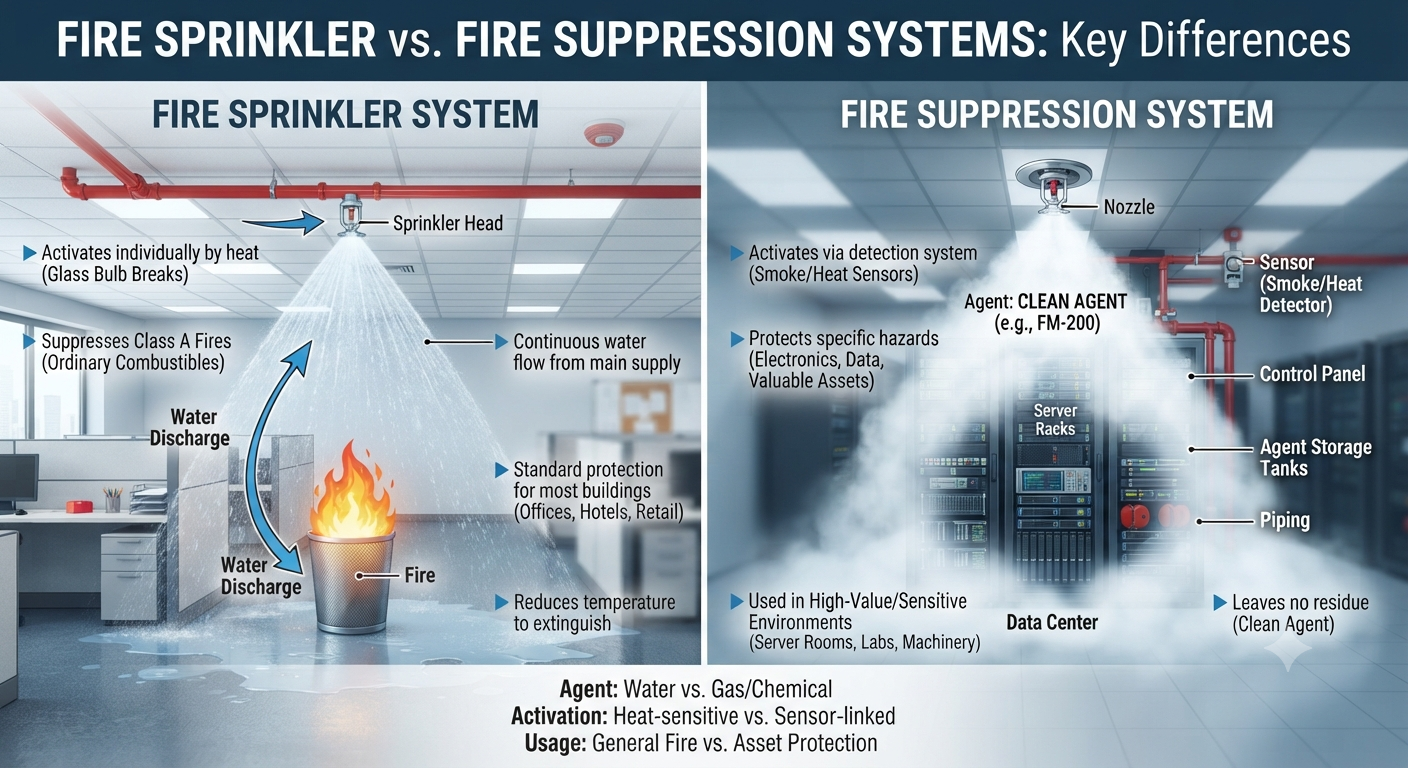
A fire sprinkler system is an automatic fire protection system that uses water to control or extinguish a fire. When the temperature around an individual sprinkler head reaches a predetermined level (typically around 68°C), only that sprinkler head activates and releases water directly onto the fire.
Contrary to a common misconception, all sprinkler heads do not activate simultaneously. Only the sprinkler closest to the heat source opens, helping minimize unnecessary water discharge.
A fire suppression system is designed to extinguish fires using an extinguishing agent other than water. Depending on the application, the suppression agent may include:
These systems are commonly installed where water could damage expensive equipment or where rapid fire suppression is critical.
A fire suppression system usually detects smoke or heat automatically and releases the suppression agent throughout the protected area to extinguish the fire quickly.
| Feature | Fire Sprinkler System | Fire Suppression System |
|---|---|---|
| Extinguishing Agent | Water | Gas, Foam, CO₂, Clean Agent, Dry Powder |
| Activation | Heat activates individual sprinkler heads | Smoke or heat detection triggers the system |
| Best For | Offices, Warehouses, Residential Buildings | Data Centers, Server Rooms, Electrical Rooms |
| Water Damage | Possible | No water damage (Clean Agent Systems) |
| Response Speed | Fast | Very Fast |
| Equipment Protection | Moderate | Excellent |
| Installation Cost | Lower | Higher |
| Maintenance | Regular Inspection | Specialized Maintenance |
A sprinkler system remains pressurized with water at all times. When heat reaches the activation temperature, the glass bulb or fusible link inside the sprinkler head breaks, allowing water to flow directly onto the fire.
The system continues discharging water until the fire department or maintenance personnel shut it off. This method is highly effective for controlling fires in large occupied buildings.
Fire suppression systems use intelligent fire detection technology. Once smoke, flame, or excessive heat is detected:
This entire process usually takes only a few seconds.
A fire sprinkler system is ideal if your building:
A fire suppression system is the better choice if your facility contains:
Since these environments contain expensive equipment, using water could cause severe secondary damage.
Yes. Many modern commercial and industrial buildings install both systems to achieve comprehensive fire protection.
This layered approach provides maximum safety for both occupants and valuable assets.
There is no single "best" solution. The right choice depends on your building type, fire risks, and the assets you need to protect.
Choose a fire sprinkler system if you need cost-effective protection for general commercial or residential spaces.
Choose a fire suppression system if your priority is protecting sensitive electronics, critical infrastructure, or high-value equipment from both fire and water damage.
A professional fire safety assessment helps determine the most suitable solution for your facility.
Installing a fire protection system is only the first step. Regular maintenance ensures the system performs correctly during an emergency.
Routine servicing improves reliability, ensures regulatory compliance, and extends the lifespan of your fire protection systems.
Fire suppression systems and fire sprinkler systems both play vital roles in protecting lives and property, but they are designed for different applications.
A sprinkler system uses water to control fires and is ideal for offices, warehouses, hotels, factories, and residential buildings. A fire suppression system uses specialized agents such as clean gases, foam, or CO₂ to extinguish fires without damaging sensitive equipment, making it the preferred choice for data centers, server rooms, electrical facilities, and mission-critical environments.
Selecting the right fire protection solution depends on your building, operational requirements, and the assets you need to protect. Consulting experienced fire safety professionals ensures your facility receives a compliant, reliable, and effective fire protection system.
D'Park Corporation specializes in the design, installation, testing, commissioning, and maintenance of fire protection systems across commercial, industrial, and institutional projects. Our customized fire safety solutions help organizations protect lives, property, and business continuity.
D'Park Corporation – We Serve to Save.
A fire sprinkler system uses water to control fires, while a fire suppression system uses clean agents, foam, CO₂, or dry chemicals to extinguish fires without water.
A clean agent fire suppression system is the preferred solution because it protects sensitive electronic equipment without causing water damage.
No. Only the sprinkler head exposed to sufficient heat activates, reducing unnecessary water discharge.
Yes. Fire suppression systems generally have a higher installation cost due to specialized extinguishing agents and equipment.
Yes. Many commercial buildings use sprinkler systems for general areas and fire suppression systems for critical rooms to provide comprehensive fire protection.