.jpeg)
Managing movement in and around a facility is an important part of modern security. Whether it is a corporate office, industrial plant, residential complex, warehouse, hospital, educational institution, commercial building, or parking area, controlling who can enter and exit helps improve security, organization, and operational efficiency.
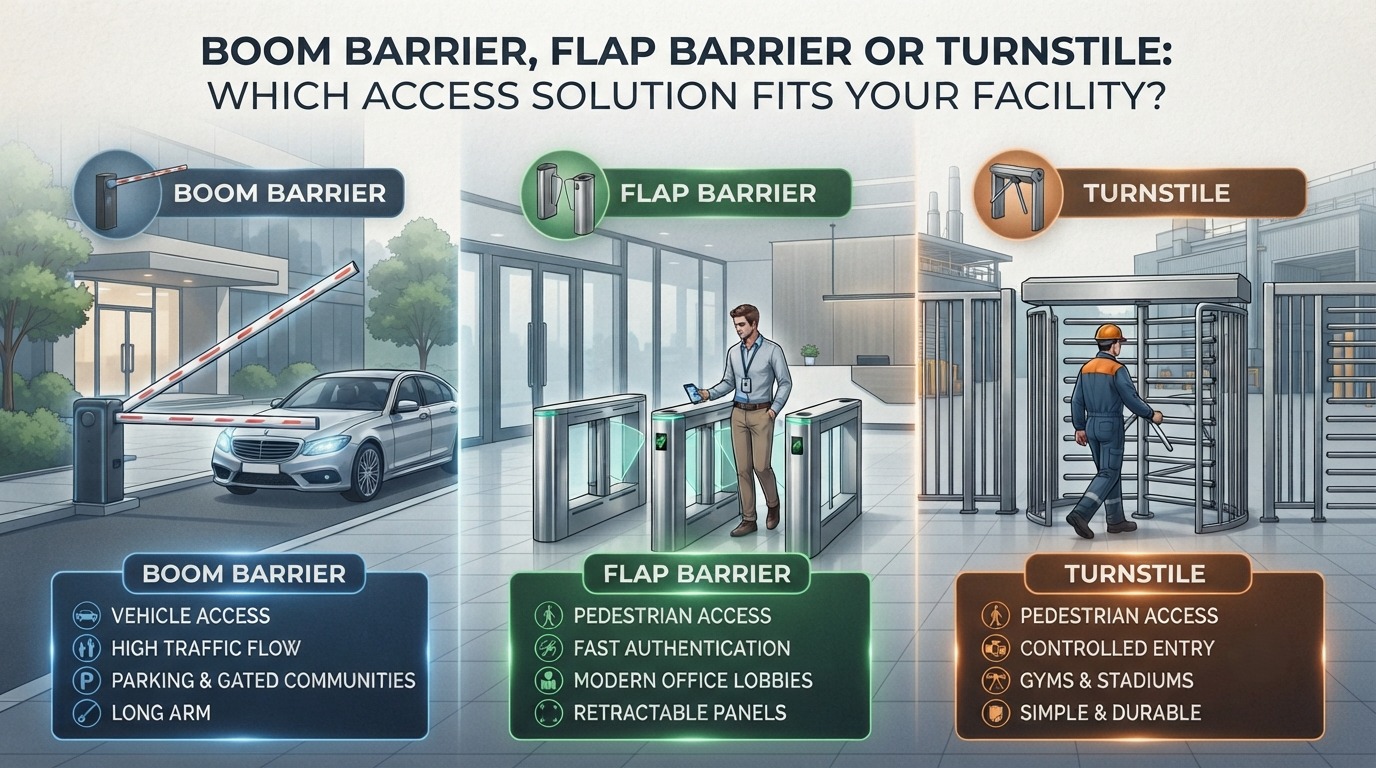
However, not every facility needs the same access control solution. A parking entrance may require a Boom Barrier, while a corporate lobby may benefit from a Flap Barrier. A high-traffic employee entrance may be better suited to a Turnstile.
So, how do you choose the right one?
In this guide, we will compare Boom Barriers, Flap Barriers, and Turnstiles, explain how they work, highlight their applications and benefits, and help you understand which access solution may be suitable for your facility.
An access control barrier is a physical security device designed to regulate the movement of vehicles or people through a controlled entry or exit point. These systems can work with technologies such as RFID cards, access cards, biometric devices, QR codes, ticketing systems, ANPR cameras, remote controls, or other access management technologies. The objective is simple: allow authorized movement while restricting or monitoring unauthorized access. Depending on the application, access barriers can help organizations improve security, reduce unauthorized entry, manage traffic, and maintain better control over facility access.
A Boom Barrier is primarily designed to control vehicle entry and exit. It consists of a motorized arm that moves upward or downward to allow or restrict vehicle movement. Boom barriers are commonly installed at parking entrances, corporate facilities, residential societies, warehouses, factories, hotels, hospitals, and commercial properties.
When an authorized vehicle approaches the entrance, the system receives an access signal. Depending on the configuration, this signal may come from an RFID card, remote control, access controller, ANPR camera, ticketing system, or other integrated technology.
Once authorization is confirmed, the barrier arm rises and allows the vehicle to pass. After the vehicle crosses the designated area, the arm can automatically return to its closed position.
Boom barriers are ideal when the primary security requirement involves controlling vehicles rather than pedestrians.
Common applications include:
A Flap Barrier is a pedestrian access control solution generally installed at building entrances, reception areas, office lobbies, metro stations, commercial facilities, and other locations where controlled pedestrian movement is required. Instead of a long horizontal arm used by a Boom Barrier, a Flap Barrier uses retractable panels or flaps that open when an authorized person is granted access.
A user presents an authorized credential, such as an access card, RFID card, QR code, biometric identification, or another approved authentication method. The access control system verifies the credential. If authorization is successful, the flaps open and allow the person to pass through. After the person crosses the access point, the flaps close automatically. This makes Flap Barriers particularly useful for organizations that want controlled pedestrian movement with a modern and professional appearance.
Flap barriers are generally suitable for facilities where people need to pass through controlled entry points.
Typical applications include:
A Turnstile is another popular pedestrian access control solution. It is designed to allow controlled movement of people through an entrance while generally allowing one person to pass per authorized access event. Turnstiles are available in different designs, including tripod turnstiles, full-height turnstiles, and other specialized configurations.
A person presents an access credential to the connected access control system. After authorization, the turnstile unlocks or rotates, allowing the authorized individual to pass.
The system can then return to its locked position, helping prevent unauthorized passage. Turnstiles can be particularly useful in locations where a large number of people need to move through controlled access points efficiently.Turnstiles are suitable for locations where controlled pedestrian flow is important.
Common applications include:
Although all three solutions are designed to control access, their applications are different.
The right choice depends on several factors, including the type of traffic, security requirements, available space, expected number of users, integration requirements, and the overall design of the facility.
The first question is whether you need to control vehicles or people. If your primary requirement is vehicle access, a Boom Barrier is usually the more appropriate choice. If the requirement is pedestrian access, consider a Flap Barrier or Turnstile.
Think about how many vehicles or people will pass through the access point during busy periods. High-traffic facilities may require an access solution designed for frequent operation. Selecting the right equipment based on expected traffic can help improve operational efficiency.
Different facilities have different security requirements. A manufacturing plant, corporate office, hospital, and residential complex may require different access policies. Consider whether you need RFID, biometric authentication, ANPR, QR-code access, visitor management, attendance integration, or centralized access monitoring.
Available installation space can also influence your decision. Before selecting an access barrier, evaluate the entrance layout, pedestrian movement, vehicle lanes, emergency routes, and surrounding infrastructure.
Modern access control systems are often integrated with other security technologies. For example, a Boom Barrier can be integrated with RFID readers, ANPR cameras, parking management software, or access control systems. Flap Barriers and Turnstiles can integrate with RFID cards, biometric systems, QR codes, attendance systems, and centralized access management platforms. Integration can help create a more connected and manageable security environment.
Choosing the right access control equipment is only one part of the solution. Proper installation and configuration are equally important. An incorrectly positioned barrier, poorly configured access controller, unstable network connection, or improperly integrated reader can affect the performance of the entire system. Professional installation can help ensure that the access solution is correctly positioned, configured, tested, and integrated with other systems.
Access control equipment operates frequently and may be exposed to dust, weather, electrical fluctuations, mechanical stress, or continuous usage. Regular maintenance can help identify potential problems before they affect daily operations. Maintenance may include checking mechanical components, sensors, access readers, wiring, communication connections, control panels, emergency release functions, and system configurations. Preventive maintenance can improve reliability and help extend the useful life of access control equipment.
Yes. A facility may require more than one access solution depending on its layout and security requirements. For example, a corporate campus may use a Boom Barrier at the vehicle entrance, Flap Barriers at the main reception, and Turnstiles at an employee entrance. These systems can potentially be integrated with a centralized access control platform, CCTV surveillance, visitor management, attendance systems, and other security technologies. This layered approach can provide better visibility and control across different access points.
A Boom Barrier, Flap Barrier, or Turnstile is only one part of an effective access management system. A complete solution should consider authentication, authorization, monitoring, visitor management, emergency access, system integration, maintenance, and operational policies. The objective is not simply to stop people or vehicles. The objective is to create a controlled, efficient, and secure movement environment.
Choosing between a Boom Barrier, Flap Barrier, and Turnstile depends on what you need to control and how your facility operates.
A Boom Barrier is an effective choice for vehicle access and parking management. A Flap Barrier can provide controlled and professional pedestrian access for offices and commercial facilities. A Turnstile can be useful for managing high-volume pedestrian movement in industrial, corporate, educational, and other controlled environments.
The best solution is the one that matches your facility's security requirements, traffic volume, layout, technology needs, and future expansion plans.
At D'Park Corporation, we provide integrated security and access control solutions designed around the specific requirements of businesses, industries, offices, residential facilities, and commercial properties. From Boom Barriers, Flap Barriers, Turnstiles, Access Control, CCTV Surveillance, Parking Management, Fire Alarm & Detection to complete security infrastructure, proper planning, installation, commissioning, and maintenance can help create a safer and more controlled facility.
Because secure access is not just about who enters. It is about knowing, managing, and controlling access.
D’PARK CORPORATION – We Serve to Save.
Best Fire and Security Solution | Indore | Pan India