What Is a Calorimeter and How Does It Work?
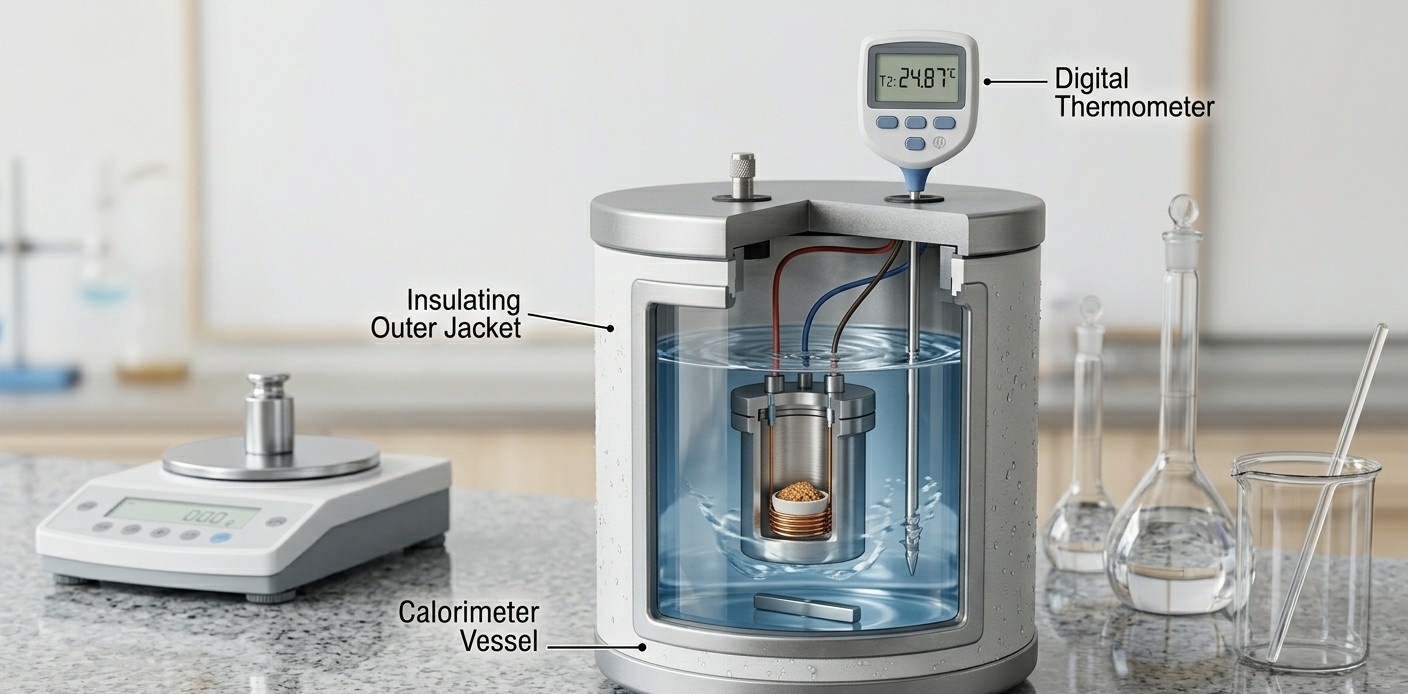
A calorimeter is an important scientific instrument used to measure the heat energy released or absorbed during a chemical reaction, physical change, or combustion process. It plays a crucial role in thermodynamics, chemistry, physics, food science, and engineering.In simple words, a calorimeter helps scientists understand how much heat energy is involved when something is heated, cooled, burned, or reacts with another substance.
This device is designed in such a way that heat exchange can be measured very accurately without losing energy to the surroundings. Because of this property, calorimeters are widely used in laboratories, industries, research centers, and even food testing facilities.
Calorimetry is the branch of science that deals with measuring heat energy changes in a system. A calorimeter is the physical device used for this measurement. Every physical and chemical process involves energy changes. Some reactions release heat (exothermic), while others absorb heat (endothermic). Calorimeters help in measuring these energy changes precisely.
In scientific studies, understanding heat transfer is very important because:
- It helps explain reaction behavior
- It supports energy efficiency studies
- It is useful in material development
- It helps in environmental analysis
A calorimeter ensures that the system is insulated so that no heat is lost to the surroundings, giving accurate results.
The working of a working calorimeter is based on a fundamental scientific principle:
Heat lost = Heat gained
This is derived from the Law of Conservation of Energy, which states that energy cannot be created or destroyed, only transformed from one form to another.
When a hot object is placed in a cooler environment:
- Heat flows from hot to cold
- Temperature equalizes over time
- The total energy remains constant
Mathematical form:
Q = mcΔT
Where:
- Q = Heat energy
- m = Mass of substance
- c = Specific heat capacity
- ΔT = Temperature change
Important concept:
- If reaction releases heat → temperature increases
- If reaction absorbs heat → temperature decreases
This principle helps scientists calculate unknown heat values in reactions.
Different calorimeters are used for different purposes depending on accuracy, application, and complexity.
Simple Calorimeter
A simple calorimeter is commonly used in school and college laboratories. It consists of a metal container, thermometer, and stirrer.
It is mainly used for:
- Basic heat transfer experiments
- Measuring heat changes in liquids
- Educational demonstrations
Bomb Calorimeter
A bomb calorimeter is a highly advanced and sealed device used to measure heat released during combustion reactions.
It is widely used in:
- Fuel testing (petrol, diesel, coal)
- Food energy measurement
- Chemical research
Key features:
- Strong steel container (resistant to pressure)
- Oxygen-filled chamber
- Water bath for heat measurement
Coffee Cup Calorimeter
This is a simple and cost-effective device used for reactions in liquid solutions.
It is used in:
- Chemical experiments in labs
- Measuring reaction enthalpy
- Student-level experiments
Differential Scanning Calorimeter (DSC)
This is a highly advanced instrument used in research industries.
It helps in:
- Studying polymers
- Material testing
- Pharmaceutical research
It measures heat flow differences between sample and reference material.
A calorimeter is designed to prevent heat loss and ensure accurate measurement.
Main components include:
- Insulated container : Prevents heat exchange with the environment
- Thermometer: Measures temperature changes
- Stirrer: Ensures uniform heat distribution
- Reaction chamber: Where the process occurs
- Water jacket (in advanced models): Helps absorb heat
Important design principle:
- The system must be fully insulated
- No external heat should interfere with readings
The working of a calorimeter follows a systematic procedure to measure heat accurately.
- Step 1: Preparation A known quantity of substance is placed inside the calorimeter.
- Step 2: Initial Measurement Initial temperature is recorded carefully.
- Step 3: Reaction Start A chemical reaction or physical process is initiated.
- Step 4: Heat Exchange Heat is either released or absorbed by the system.
- Step 5: Final Temperature Final temperature is recorded after stabilization.
- Step 6: Calculation Heat change is calculated using formulas.
Example:
In combustion:
- Fuel burns inside sealed chamber
- Heat is transferred to water
- Temperature rise is measured
- Energy content is calculated
Calorimeters are widely used in various fields due to their accuracy in measuring energy changes.
Food Industry
- Measures calorie content in food
- Helps in nutrition labeling
- Supports diet planning
Fuel Industry
- Tests efficiency of fuels
- Compares energy output of different fuels
- Helps improve fuel performance
Chemical Industry
- Studies reaction heat Helps in process optimization Used in production design
Medical Science
- Studies metabolism rate
- Helps in drug development
- Used in biochemical analysis
Material Science
- Tests heat resistance
- Helps develop new materials
- Used in polymer research
Calorimeters are very useful instruments but also have certain limitations.
Advantages:
- Highly accurate measurement of heat
- Useful in multiple industries
- Helps in scientific research
- Supports energy efficiency studies
- Easy to use in controlled environments
Limitations:
- Expensive advanced models
- Requires perfect insulation
- Sensitive to environmental changes
- Errors in measurement can affect results
Key insight:
Precision and insulation are the most important factors in calorimetry.
Calorimeters play a very important role in modern scientific development and industrial progress.
Importance in today’s world:
- Helps in renewable energy research
- Used in battery technology development
- Supports environmental studies
- Improves fuel efficiency systems
- Helps in chemical engineering advancements
Real-world impact:
Calorimetry is a foundation of thermodynamics and energy science, making it essential for future innovation.
A calorimeter is a powerful scientific device used to measure heat energy changes in different processes. It helps scientists understand how energy is transferred during reactions, combustion, and physical changes. From simple school experiments to advanced industrial research, calorimeters play a key role in science and technology. They are essential for food testing, fuel analysis, chemical research, and material development.
In today’s world, accurate measurement of energy is crucial for efficiency, safety, and innovation. Calorimeters provide the scientific foundation needed to understand these processes. At D’PARK CORPORATION we are committed to promoting advanced safety systems, ELV solutions, fire protection technologies, and smart infrastructure development. Our vision supports modern innovation and safety excellence with the mission: Best Fire and Security Solution Indore Pan India Calorimetry, like modern safety systems, reflects how science helps us measure, control, and improve energy and safety in the world with precision, reliability, and innovation.